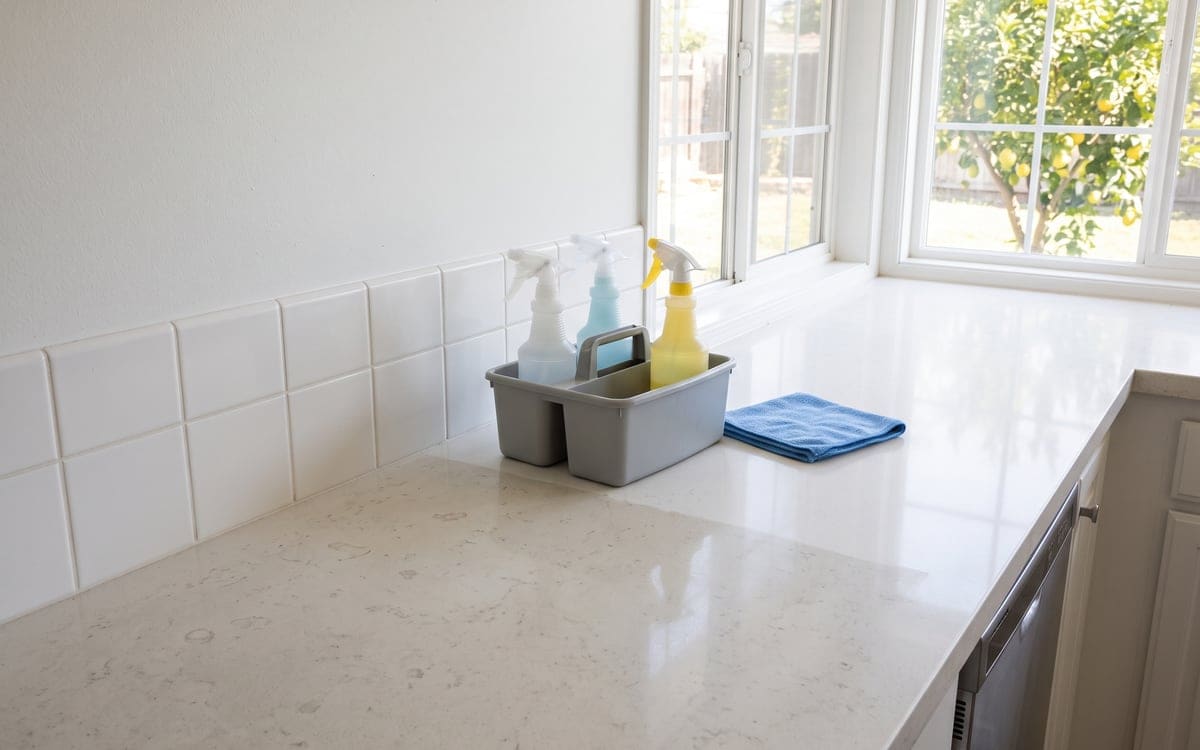
What a regular clean keeps up
A regular visit resets the surfaces the household touches most: the kitchen counters, the sink, the stovetop and the fronts of the appliances; the tub or shower, the toilet, the vanity and the mirror in each bathroom; the furniture surfaces anyone uses in a living room or a bedroom; the floors last. The guide to what a cleaning covers room by room has the whole list in order.
What a deep clean adds
Dust and film settle on surfaces nobody looks at from day to day: the top of a cabinet, the slat of a vent, the frame above a door, the switch plate behind the kitchen door and the inside of the shower-door track. A deep clean works through those surfaces as well as the regular ones. High dusting is done from the floor, so cabinet tops and ceiling fan blades are reached without anyone stepping onto a chair. On the ground, the deep pass works the hood over the stove, the baseboards along a hall, grout lines in a shower, mineral film on the glass, window sills and reachable door frames. Inside the oven glass and the fridge come up on the call as extras. A regular visit never reaches the deep layer, so after a long run of weekly visits that layer is still there to work through.
Signs a deep clean comes first
A first visit is often a deep one when the home has not had a top-to-bottom pass in a while. Even a tidy home carries dust on the shelf above the shower door and film along a baseboard behind the chair that nobody has reached.
Signs of each case tend to show up before anyone opens the door.
When a regular clean keeps up, and when a deep clean comes first
The usual signs for choosing which visit a home needs right now.
A regular clean keeps up
- The home had a thorough clean not long ago
- Glass and chrome dry clear after a wipe
- A routine is already in place
A deep clean comes first
- It has been a long while
- Film on the shower glass that a wipe leaves behind
- Dust on fans, vents and the tops of cabinets
- A new schedule is about to start
Film on the shower glass that a wipe leaves behind, dust on fans and vents, a shelf above the shower door that reads gray in daylight, grease on the hood filter, grout that has darkened along the lower courses in the bathroom: these are the signs the deep layer has run ahead of a regular pass. One of them on its own is not much; several together usually mean a regular maid service will leave the home short, and a deep clean comes first.
A sharper note from one room, a bathroom or a kitchen that reads of itself after a weekly pass, is another sign the deep layer in that room has run ahead of the maintenance. Grease on a hood filter is a common one.
San Diego's very hard water sits on bathroom surfaces
The U.S. Geological Survey classes water above 180 milligrams per liter of hardness as very hard, and all three City treatment plants delivered very hard water in 2025, averaging 237, 242 and 243 parts per million. USGS also says hard water leaves spots or film on glassware and makes soap form soap scum.
A regular clean handles the shower surfaces, with soap scum lifted off the tile and the fixtures wiped down. A deep clean takes the mineral film off the glass, works the grout along the lower courses, and clears the dried spots that collect at the base of each faucet.
A shower that gets a weekly pass still carries two layers between the glass panel and the tile: the greasy film from soap on top, and the chalky residue from the water drying on the surface underneath. A regular visit lifts the top layer so the next week starts clean; a deep visit works through both layers.
Kitchen fixtures run through the same water as the shower. The base of a sink faucet, the ring where the kettle sits, the handles of a pot filler on the backsplash and the inside of the dishwasher gasket all pick up a white film that a regular visit flattens and a deep visit cleans off.
A deep clean, then a schedule
A deep visit is the first big reset. Starting straight into a schedule without a deep reset at the start usually means the first scheduled visit carries the deep layer, and the layer then surfaces again on the second visit and the third.
A home that was just taken top to bottom on its own, by the household or during a renovation, is a different case, and a regular visit is a reasonable start there.
When it is really a move-out clean
A move-out clean is a deep visit done in an empty place. With no furniture, laundry basket or stack of mail on the counter, cleaners can reach the floor of each closet, every baseboard along its full length and the inside of every cabinet, because nothing sits in front of them. Appliances stay in place; the reachable floor under them gets a wipe when it would otherwise be hidden. A deep visit in a lived-in home works around what the household owns. A move-out visit starts at the ceiling and finishes at the entry door with nothing between the cleaner and the surface.
Which visit a home needs first turns on two questions: how long since a top-to-bottom pass, and whether the home is empty or lived-in. The cost guide covers how each job is priced on its own terms.
Side by side, room by room
The table below marks what tends to shift between a regular visit and a deep one.
| Area | Regular clean | Deep clean |
|---|---|---|
| Counters and sink | Wipe, dry, scrub the sink | Everything the regular pass does, with the base of the faucet and the ring under the kettle |
| Stovetop and oven exterior | Stovetop and drip pans wiped | Pieces lifted off the stovetop, hood and filter cleaned, the oven glass when the household asks |
| Refrigerator | Doors and handles | Shelves pulled, interior wiped, the gasket run |
| Shower tile and tub | A scrub and a rinse, soap scum lifted | Grout along the lower courses, mineral film on the glass addressed, baseboards along the room |
| Toilet | The bowl, the seat, the rim, the outside | The same, with behind the base and the seat hinges |
| Dust | Reachable surfaces top down | Cabinet tops and fan blades reached from the floor, baseboards, switch plates, door frames |
| Floors | Vacuum, damp mop on hard floors | A pass under light furniture that moves aside, closet floors, the corner behind each door |
| Windows | Fingerprints on the inside glass | Sashes, sills and the window tracks on anything that opens from inside |
What a deep clean does not fix
Cleaning stops where repair starts. A deep visit will not patch drywall, refinish a floor, repaint an older sill or bring back grout that has crumbled past cleaning. Surface spots on tile and grout are as far as we go on mold; anything that spreads, sits on drywall or wood, smells musty or follows a leak is for a mold professional. Fine drywall dust from a remodel is outside the maid-visit toolkit too, and a post-construction job uses its own method for that. If one of those is the real need, we say so on the call and name the trade.
Products are a smaller question, and we go over which ones get used on the first call. Never mix bleach with ammonia, vinegar or any other cleaner, in any part of the home.